
 English
  日本語
日本語  Deutsch
  Español




What ever was the point of glass?
Content
- 1 The Point of Glass: A Material That Quietly Holds Civilization Together
- 2 What Glass Actually Is and Why Its Properties Matter
- 3 Glass Windows Changed the Way Humans Built and Lived
- 4 Optical Glass Gave Humanity New Eyes
- 5 Glass in Science and Medicine: The Laboratory Would Not Exist Without It
- 6 Glass and the Preservation of Food and Knowledge
- 7 Fiber Optic Glass: How the Internet Travels the World
- 8 Glass in Energy: Solar Panels and Insulation
- 9 The Screen in Your Hand Is Glass
- 10 A Brief Timeline: How Glass Changed Everything
- 11 Why Glass Gets Overlooked Despite Its Importance
- 12 Glass Remains Irreplaceable in Most of Its Core Uses
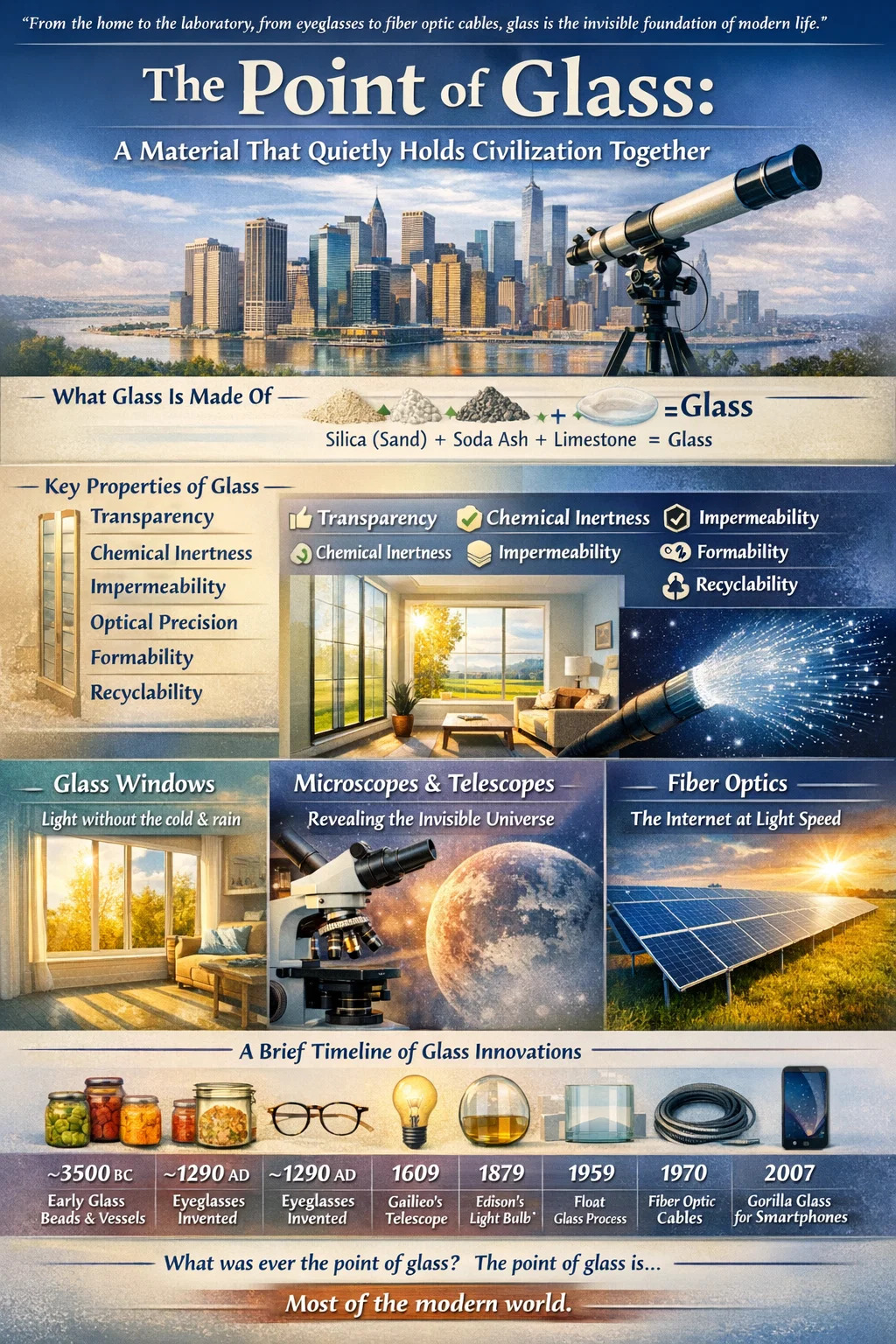
The Point of Glass: A Material That Quietly Holds Civilization Together
Glass was the point. It still is. Few materials have done more to shape how humans live, think, see, and survive — yet because glass is everywhere, it's easy to take for granted or even dismiss as ordinary. The question "what was ever the point of glass?" is worth taking seriously, because the answer reveals just how much of modern life depends on a material that is essentially sand, transformed.
Glass allowed people to have light inside buildings without letting in wind and rain. It let scientists see things too small for the naked eye. It carried information as light across continents. It preserved food, protected medicines, and built telescopes that changed humanity's understanding of the universe. Without glass, the Scientific Revolution, the Industrial Revolution, and the modern communication age would each have looked radically different — or not happened at all.
What Glass Actually Is and Why Its Properties Matter
Glass is an amorphous solid — it has no crystalline structure, which is part of what makes it so useful. At its most basic, soda-lime glass (the most common type) is made from silica (sand), sodium carbonate (soda ash), and calcium carbonate (limestone). These are among the most abundant materials on Earth, which is one reason glass has been produced for thousands of years across nearly every culture.
The properties that make glass remarkable include:
- Transparency: Glass transmits visible light while blocking wind, water, and contamination. No other common, durable material does both.
- Chemical inertness: Glass doesn't react with most foods, beverages, or chemicals. It doesn't leach substances into its contents, which is why it remains the gold standard for laboratory and pharmaceutical use.
- Impermeability: Unlike wood, clay, or fabric, glass doesn't absorb liquids or gases, making it ideal for airtight storage.
- Optical clarity and precision: Glass can be ground and polished to exact specifications, allowing light to be bent, focused, and directed with extraordinary accuracy.
- Formability: In its molten state, glass can be blown, pressed, cast, drawn into fibers, or float-formed into flat sheets of almost any dimension.
- Recyclability: Glass can be melted down and reformed indefinitely without loss of quality.
No single synthetic material combines all of these properties. Each one opened a different chapter in human history.
Glass Windows Changed the Way Humans Built and Lived
Before window glass became widely available, buildings had a fundamental problem: openings that let in light also let in cold, wind, insects, and rain. The solutions — wooden shutters, oiled cloth, animal hides — all blocked most of the light. Buildings were either dark or drafty.
The Romans used small panes of cast glass in some windows as early as the 1st century AD, but the quality was poor — greenish, uneven, and barely transparent. It wasn't until the medieval period that glassmaking improved enough to produce the stained glass windows of Gothic cathedrals, and not until the 17th and 18th centuries that clear, flat glass became accessible to ordinary homes.
The introduction of the float glass process by Pilkington in 1959 made large, perfectly flat, optically clear glass affordable at scale. This is the glass in virtually every modern window. It transformed architecture — buildings could now be primarily glass, maximizing natural light while maintaining thermal separation from the outside world.
The health implications were also significant. Natural light inside homes is linked to better sleep, mood regulation, and vitamin D synthesis. Before glass windows, people in cold climates spent long winters in dim, sealed rooms. Glass didn't just make buildings more comfortable — it changed the quality of indoor life for billions of people.
Greenhouse Glass and the Food Supply
Glass greenhouses extended growing seasons and allowed cultivation of crops in climates where they would otherwise be impossible. The Netherlands, for example, has become one of the world's largest exporters of vegetables and flowers — including tomatoes, peppers, and cucumbers — largely through the use of enormous glass greenhouse complexes. The Netherlands exports agricultural products worth over €100 billion per year, much of it produced under glass in a country that is mostly flat and frequently cloudy. That's what glass made possible.
Optical Glass Gave Humanity New Eyes
The invention of the optical lens — a precisely shaped piece of glass that bends light — is one of the most consequential developments in human history. It didn't just help people see better. It fundamentally changed what humans could perceive and therefore what they could discover.
Eyeglasses: Extending Productive Life by Decades
Eyeglasses were developed in northern Italy around 1290. Before them, presbyopia — the loss of near vision that typically begins around age 40 — effectively ended a person's ability to read, write, or do fine detailed work for the last half of their life. Scholars, scribes, craftsmen, and artisans had a working lifespan severely curtailed by failing eyesight.
With eyeglasses, a scholar of 60 could read as well as one of 30. The historian David Landes argued that the invention of spectacles effectively doubled the productive intellectual lifespan of educated Europeans. Today, roughly 2.2 billion people worldwide use corrective lenses — eyeglasses or contact lenses — to function normally in daily life. For all of them, glass (or glass-derived optical materials) is essential.
The Microscope: Revealing the Invisible World
The compound microscope, developed in the late 16th century using glass lenses, opened an entirely new domain of reality. Antonie van Leeuwenhoek's improvements to lens grinding in the 1670s allowed him to observe bacteria, protozoa, and red blood cells for the first time in history. Before glass lenses fine enough to magnify at this scale, the microbial world was completely unknown.
The germ theory of disease, the development of antibiotics, vaccines, surgical sterilization, food safety standards — all of this traces directly back to what glass lenses made visible. The death toll from infectious disease began its long decline only after microbiology emerged as a science, and microbiology depended entirely on glass.
The Telescope: Rewriting the Cosmos
Galileo's use of a glass telescope in 1609 to observe the moons of Jupiter, the phases of Venus, and the mountains of the Moon directly challenged the geocentric model of the universe. Within decades, Newton's refracting telescope and later reflecting telescope designs — all built around precisely shaped glass — made astronomical observation a systematic science.
Modern space telescopes like the Hubble use extraordinarily precise glass mirrors. The Hubble's primary mirror is 2.4 meters in diameter and ground to a smoothness accurate to within 10 nanometers — about 1/10,000th the width of a human hair. That precision, only achievable in glass, allowed Hubble to produce images that changed cosmology.
Glass in Science and Medicine: The Laboratory Would Not Exist Without It
The modern chemistry and biology laboratory is built around glass. Beakers, flasks, test tubes, pipettes, petri dishes, condensers, burettes, and volumetric glassware are all made from borosilicate glass — a formulation developed by Otto Schott in the 1880s that resists thermal shock and chemical attack far better than ordinary soda-lime glass.
The reason glass dominates laboratory use is straightforward: scientists need to observe reactions as they happen, and they need containers that won't contaminate the substances inside them. Glass provides both. It's transparent, heat-resistant, and chemically inert to almost everything a chemist would work with in standard conditions.
Pharmaceutical manufacturing still relies heavily on glass vials and ampoules for injectable medications, precisely because glass doesn't interact with the drugs stored inside. When the COVID-19 vaccines were produced at unprecedented speed in 2020–2021, one of the genuine supply chain bottlenecks was the availability of pharmaceutical-grade glass vials — tens of billions of them were needed globally within a matter of months.
Glass Thermometers and the Measurement of Temperature
The ability to measure temperature accurately — essential for medicine, chemistry, metallurgy, cooking, and weather science — depended on glass. The glass thermometer, in which a liquid (originally alcohol, later mercury) expands inside a narrow sealed glass tube, was one of the key measurement instruments of early modern science. Before glass could be drawn into precise, thin-walled tubes, no reliable thermometer was possible.
Glass and the Preservation of Food and Knowledge
Two of the most fundamental human concerns — keeping food safe and preserving information — both have deep connections to glass.
Glass Containers and Food Safety
Nicolas Appert's development of food preservation by heat treatment in glass jars around 1806 — the precursor to modern canning — was a genuine breakthrough in food security. For the first time, food could be preserved for months or years without salt, smoking, or drying. Appert's method was adopted by the French military, and variations of it spread globally.
The principle worked because glass could be sealed airtight after heating, preventing microbial contamination. The transparency of glass also meant spoilage could often be spotted visually — cloudiness, discoloration, or a broken seal were visible warnings. No equivalent system existed before glass containers were available at scale.
The Printing Press and Optical Glass
The relationship between glass and the spread of literacy is indirect but real. The same period that saw rapid improvement in glass production — the 15th and 16th centuries in Europe — also saw the spread of the printing press. Eyeglasses meant that literate people could continue reading throughout their lives, increasing demand for books and the economic viability of printing. Some historians argue that eyeglasses were a necessary precondition for the explosion of literacy that followed Gutenberg's press.
Fiber Optic Glass: How the Internet Travels the World
One of the most remarkable modern uses of glass is invisible to almost everyone who depends on it. Fiber optic cables — thin strands of extremely pure glass — carry the majority of the world's internet traffic, telephone calls, and financial transactions. Light pulses travel through these glass fibers, bouncing along the interior by total internal reflection, carrying data at speeds approaching the speed of light.
There are over 1.3 million kilometers of submarine fiber optic cables laid on the ocean floor, connecting every continent. These cables handle an estimated 95% of all international internet traffic. The glass used in fiber optics must be extraordinarily pure — impurities that would be undetectable in window glass would cause signal loss in fiber optic cable over long distances.
Corning, one of the leading manufacturers of specialty glass, developed low-loss optical fiber in 1970 — a breakthrough that made long-distance fiber optic communication practical. The same company that made glass for Thomas Edison's light bulbs in the 1880s is still central to global communications infrastructure today. That's a remarkable continuity.
Every email sent, every video streamed, every financial transaction processed internationally almost certainly passes through glass at some point. The internet, in a very physical sense, runs on glass.
Glass in Energy: Solar Panels and Insulation
Glass plays two significant roles in modern energy systems — one in generation, one in conservation.
Solar Glass and Photovoltaic Panels
Solar panels are covered with low-iron tempered glass that transmits maximum sunlight to the photovoltaic cells beneath while protecting them from weather, impact, and degradation. The glass used is a specialized low-iron formulation — ordinary glass has a greenish tint from iron content that absorbs some of the light energy. Solar glass is produced to minimize this absorption.
Global solar panel installation has grown from about 40 gigawatts of total capacity in 2010 to over 1,400 gigawatts by 2023 — each panel requiring a sheet of specialized glass. As the world's energy system transitions away from fossil fuels, glass is a core enabling material.
Double Glazing and Building Energy Efficiency
Double and triple-glazed glass windows — two or three panes with an insulating gas-filled gap between them — dramatically reduce heat loss from buildings. In cold climates, windows historically represented the biggest source of heat loss in a building. Modern double-glazed units can have a U-value (heat transfer coefficient) of around 1.2 W/m²K compared to 5.7 W/m²K for single glass — meaning they lose roughly five times less heat. At scale across millions of buildings, this translates into enormous reductions in heating energy demand.
The Screen in Your Hand Is Glass
The screen of every smartphone, tablet, and laptop is glass. Not just any glass — chemically strengthened glass, most famously Corning's Gorilla Glass, which is treated with a potassium salt bath that compresses the surface layer, making it resistant to scratching and shattering.
Before the development of durable, thin, touchscreen-compatible glass, the smartphone as we know it wasn't possible. Steve Jobs famously insisted on a glass screen for the original iPhone in 2007, rejecting the plastic alternatives that were initially proposed because they scratched too easily. Corning produced Gorilla Glass — a product they had shelved for decades — within months of that request. Over 8 billion Gorilla Glass devices had been shipped by 2020.
The glass in a modern smartphone screen is typically less than 1mm thick, yet it survives being dropped, carried in pockets with keys, and tapped thousands of times. It transmits touch input with precision, remains optically clear, and resists the oils and moisture of constant handling. It is an extraordinarily engineered product that most people think of as simply "the screen."
A Brief Timeline: How Glass Changed Everything
| Period | Glass Development | Impact |
|---|---|---|
| ~3500 BC | First manufactured glass objects (Mesopotamia/Egypt) | Decorative beads, early vessels |
| ~50 BC | Glassblowing invented (Levant region) | Mass production of vessels; widespread storage and trade |
| ~1290 AD | Eyeglasses invented (Italy) | Extended intellectual productivity; precondition for literacy boom |
| ~1590 | Compound microscope developed | Discovery of microbial world; foundation of modern medicine |
| 1609 | Galileo uses telescope | Astronomical revolution; heliocentric model confirmed |
| 1806 | Appert develops glass-jar food preservation | Foundation of modern food canning and storage |
| 1879 | Edison's glass light bulb | Practical electric lighting; transformed night-time productivity |
| 1959 | Float glass process (Pilkington) | Affordable flat glass; modern architecture and glazing |
| 1970 | Low-loss optical fiber (Corning) | Global telecommunications and internet infrastructure |
| 2007 | Gorilla Glass for iPhone | Touchscreen smartphones; mobile computing revolution |
Why Glass Gets Overlooked Despite Its Importance
Part of why glass gets dismissed or taken for granted is precisely because it's transparent. You look through it, not at it. The window disappears when you focus on the view outside. The jar disappears when you focus on the food inside. The screen disappears when you're reading or watching something. Glass is designed to be invisible, and it succeeds so well that people forget it's there.
Another reason is ubiquity. When something is everywhere — in your kitchen, your windows, your phone, your car, your office — it no longer seems like a technology. It becomes part of the background. But ubiquity is a sign of success, not irrelevance.
The historian Alan Macfarlane, who co-wrote a book specifically about glass and its role in history, argued that the willingness of certain cultures to invest in glassmaking technology was closely linked to the emergence of modern science and the industrial economy. Cultures with access to high-quality optical glass could build better instruments; better instruments meant better science; better science meant better technology. The feedback loop between glass quality and scientific progress ran for centuries.
Glass Remains Irreplaceable in Most of Its Core Uses
Plastics replaced glass in some applications — bottles for water and soda, for example — but glass has held its ground or regained territory in areas where its unique properties matter most. Pharmaceutical vials remain glass. Optical instruments remain glass. Fiber optic cables remain glass. Laboratory equipment remains glass. High-quality food and beverage packaging continues to favor glass for premium products.
In several areas, glass is actively expanding. Solar panel demand is growing rapidly. Smartphone screen glass is becoming thinner, stronger, and more optically refined with each generation. Smart glass — which can switch from transparent to opaque electrically — is being incorporated into buildings, car windows, and privacy screens. Glass with embedded electrodes can function as a touch interface across an entire window surface.
The global glass market was valued at approximately $140 billion in 2022 and is projected to grow significantly through the 2030s, driven by construction, electronics, automotive, and solar energy sectors. A material with this kind of economic footprint is not one that has outlived its purpose.
So what was ever the point of glass? The point was light inside buildings, sight restored to aging eyes, bacteria revealed for the first time, the universe made visible, food preserved across seasons, information carried at light speed across ocean floors, and a screen in your pocket that responds to your fingertip. The point of glass is most of the modern world.
Recommended Products


- PRODUCT
- Glass Storage Jar
- Glass/Stainless Steel Drinking ware
- Kitchen Seasoning Containers
- Home Decoration
- QUICK LINKS
- Products
- About Us
- Manufacture
- ODM/OEM
- News
- Contact Us
- CONTACT US
-
-
 7 Crystal Boulevard xi’an Feng Town, Baoying County,Jiangsu, China.
 -
 WhatsApp:
+86-15005252638 -
 +86-15005252638
+86-18083766162
+86-15895746638
+86-0514-8866-8898
-
 joy@nchousewares.com
Jack@nchousewares.com
julia@nchousewares.com
-
- CONTACT

