
 English
  日本語
日本語  Deutsch
  Español




How Is Glass Clarity Determined? Key Factors, Standards, and Buyer Tips for Clear Glass
Content
- 1 The Four Pillars Behind Glass Clarity
- 2 Raw Material Purity: The Hidden Iron Problem
- 3 Melting and Refining: Where Bubbles Are Defeated
- 4 Annealing: The Thermal Step That Makes or Breaks Clarity
- 5 How Is Glass Clarity Measured? Standards, Instruments, and Numbers
- 6 Soda-Lime Glass vs. Borosilicate Glass: Which Is Clearer?
- 7 Why Clarity Matters for Food Storage and Drinkware
- 8 Buyer's Checklist: How to Judge Glass Clarity in Finished Products
- 9 Frequently Asked Questions About Glass Clarity
- 9.1 1. Why does my new glass jar have a green tint?
- 9.2 2. Does glass clarity affect food safety?
- 9.3 3. What is the difference between transparency and clarity?
- 9.4 4. Is borosilicate glass always clearer than soda-lime glass?
- 9.5 5. Can glass become cloudy over time?
- 9.6 6. What data should I request from a glass supplier to compare clarity?
Comparing two glass storage jars from different suppliers reveals an immediate visual difference: one catches the light with near-crystal clarity, while the other casts a slightly green and hazy glow. This is not a matter of factory luck. Glass clarity is determined by four measurable factors: raw material purity, melting and refining quality, annealing conditions, and surface finish. When a well-controlled borosilicate glass reaches the warehouse, its visible light transmittance can be 92% to 93%. When production tolerances slip, transmittance drops to the 85% to 88% range and a visible green tint appears.
The Four Pillars Behind Glass Clarity
The phrase "high-clarity glass" is used widely, but it means little without defining what clarity actually depends on. Four pillars control the final result, and they work in a cumulative chain. Let's break each down in order of influence.
- Raw material purity. Iron content is the single biggest contributor to visible tint. Iron oxide (Fe2O3) absorbs blue-violet light, while iron oxide (FeO) absorbs red, together producing the familiar greenish cast. High-purity glass keeps Fe2O3 below 0.02%, while ordinary soda-lime glass can contain 0.05% to 0.1%.
- Melting and refining. Bubbles and un-melted silica particles scatter light. A bubble larger than 0.5 mm in diameter is visible to the naked eye and dramatically reduces clarity. The combination of melting temperature, fining agents, and hold time determines how many bubbles remain.
- Annealing. Cooling rate sets internal stress. Residual stress causes birefringence, which makes objects viewed through the glass appear distorted and soft instead of sharp.
- Surface finish. Microscopic scratches or micro-cracks on the surface produce diffused scattering, raising haze. Polishing or coating can significantly improve perceived clarity.
According to a 2024 review article published in Glass International, raw material and melting stages account for roughly 80% of clarity outcomes, while annealing and surface treatment contribute about 10% each. This is why glass buyers should focus most attention on those early manufacturing stages.
Raw Material Purity: The Hidden Iron Problem
Every point of clarity loss begins at the raw material stage. Silica sand is the backbone of glass, and its purity determines the upper limit of achievable clarity. High-quality glass manufacturers require quartz sand with SiO2 content of 99.5% or higher, and iron oxide levels at or below 0.02%. The iron enters the batch naturally, carried by hematite and magnetite particles in the sand deposit.
The visual effect of iron is not theoretical. Data published in the Journal of Non-Crystalline Solids (2023) showed that soda-lime glass with 0.05% Fe2O3 has a measured luminous transmittance of approximately 89%, while the same composition with 0.02% Fe2O3 reaches 91.5%. The difference of roughly 2.5 percentage points is exactly the kind of gap that makes one glass jar look noticeably greener and duller than another.
The threshold where iron becomes visible is generally accepted at 0.03% Fe2O3. Above that, the human eye begins to perceive a mint-green tint, especially when viewing the glass through its edge. This is why consumers are more likely to see the greenish cast on cheaper storage jars and drinkware, while premium borosilicate products remain near-water-white.
Another controlled method is through chemical fining. Adding cerium oxide (CeO2) to the batch helps reduce the green tint, but it increases raw material cost. Most professional glass buyers evaluate clarity by asking for the Fe2O3 percentage in the certificate of analysis and comparing that number to the visible appearance of samples.
Melting and Refining: Where Bubbles Are Defeated
Once the raw batch is mixed, the melting stage is where clarity is either earned or lost. Soda-lime glass is melted at approximately 1450°C, while borosilicate glass requires a hotter regime around 1650°C. At these temperatures, fining agents such as sodium sulfate (Na2SO4), arsenic oxide, and sodium chloride evolve gas that helps dissolved bubbles rise to the surface and escape.
Bubbles are serious clarity enemies. A bubble larger than 0.5 mm scatters enough light to be seen as a bright white dot through the glass, and a cloud of smaller bubbles makes the entire body appear milky. The industry benchmark for high-quality glass tableware is a bubble count of no more than one bubble per kilogram of glass, measured in a production inspection.
Homogeneity is the second half of the melting battle. Even after bubbles are removed, the glass must be uniform. If the melt is not sufficiently stirred, streaks of different density form, each with a slightly different refractive index. These streaks bend light in unpredictable directions and make the glass look wavy. Modern furnaces use mechanical stirrers or controlled convection to ensure the melt is homogeneous before it passes to the forming stage. An excellent technical summary of these fundamentals is available in the company's industry article on how glass is made.
Annealing: The Thermal Step That Makes or Breaks Clarity
After glass is formed into a jar, bottle, or mug, it must be cooled slowly through a controlled temperature range. This is annealing, and it is the most underestimated factor in clarity. If glass cools too quickly, the outside contracts faster than the inside, locking in a permanent internal stress.
The critical temperatures are well known in the industry. Soda-lime glass has an annealing point around 550°C and a strain point around 510°C. Borosilicate glass anneals at around 565°C with a strain point near 520°C. Cooling rates for quality glass are kept between 1°C and 3°C per minute through this range, allowing the atomic network to rearrange gently.
Internal stress becomes visible as birefringence. When a glass jar with residual stress is viewed through a polarizing filter, you see rainbow-colored bands rather than a uniform dark field. The magnitude of the residual stress is measured in nanometers of retardation per centimeter of path length. Quality producers target values below 10 nm/cm; anything above 100 nm/cm produces visible optical distortion that makes contents look blurry.
For buyers, a simple quick check is to hold the glass in front of a polarized screen and rotate it. If the glass flashes with colored bands, the annealing quality is questionable, and clarity will also suffer.
How Is Glass Clarity Measured? Standards, Instruments, and Numbers
Clarity is not simply a subjective visual impression. Two quantitative metrics define it in the glass industry: luminous transmittance and haze.
Luminous transmittance is the percentage of visible light that passes straight through the glass, measured using a spectrophotometer equipped with an integrating sphere. The standard test procedure is defined in ASTM D1003. A perfect sheet of clear air-equivalent material would transmit 100%, but real glass always loses a bit at each surface due to Fresnel reflection. Good borosilicate glass achieves 92% to 93% transmittance; high-quality soda-lime glass reaches 90% to 91%; ordinary soda-lime often sits in the 88% to 90% range.
Haze is the percentage of scattered light within the transmitted beam. If the glass is made slightly cloudy by bubbles or uneven microstructure, the haze value rises. ASTM D1003 also defines this measurement. High-quality borosilicate glass should have haze below 0.5%; ordinary soda-lime glass can reach 0.5% to 1.5%. The table below gives a comparison of typical measured values.
| Glass Type | Luminous Transmittance | Haze | Fe2O3 Content |
|---|---|---|---|
| Ordinary soda-lime | 88% – 90% | 0.5% – 1.5% | 0.05% – 0.1% |
| Premium soda-lime | 90% – 92% | 0.3% – 0.8% | 0.02% – 0.05% |
| Borosilicate glass | 92% – 93% | < 0.5% | < 0.02% |
For a complete explanation of what constitutes "good glass" quality, see the company's article on what good glass means. This reference goes deeper into optical performance as a purchasing criterion.
Soda-Lime Glass vs. Borosilicate Glass: Which Is Clearer?
When buyers compare transparency between glass kitchenware, the material choice matters. Soda-lime glass and borosilicate glass differ in chemical composition, melting temperature, and thermal properties, and those differences translate into a consistent clue: borosilicate glass is usually clearer. Its batch is formulated with 10% to 15% B2O3, which lowers the thermal expansion coefficient and allows slower, more uniform cooling. The result is lower residual stress and less birefringence.
| Property | Soda-Lime Glass | Borosilicate Glass |
|---|---|---|
| Luminous transmittance | 88% – 92% | 92% – 93% |
| Haze | 0.3% – 1.5% | < 0.5% |
| Iron content (Fe2O3) | 0.03% – 0.1% | < 0.02% |
| Thermal expansion coefficient | 8 – 9 × 10⁻⁶ /°C | 3 – 4 × 10⁻⁶ /°C |
| Thermal shock resistance | ~60°C ΔT | ~160°C ΔT |
| Typical applications | Wide-mouth jars, water cups | Cold brew makers, double-wall mugs, vacuum jars |
A practical example is the borosilicate double-wall glass mug used for coffee and tea. Its clarity allows you to see the coffee through both walls while the vacuum layer adds insulation. The low thermal expansion of borosilicate also means less risk of accidental breakage when pouring hot liquids.
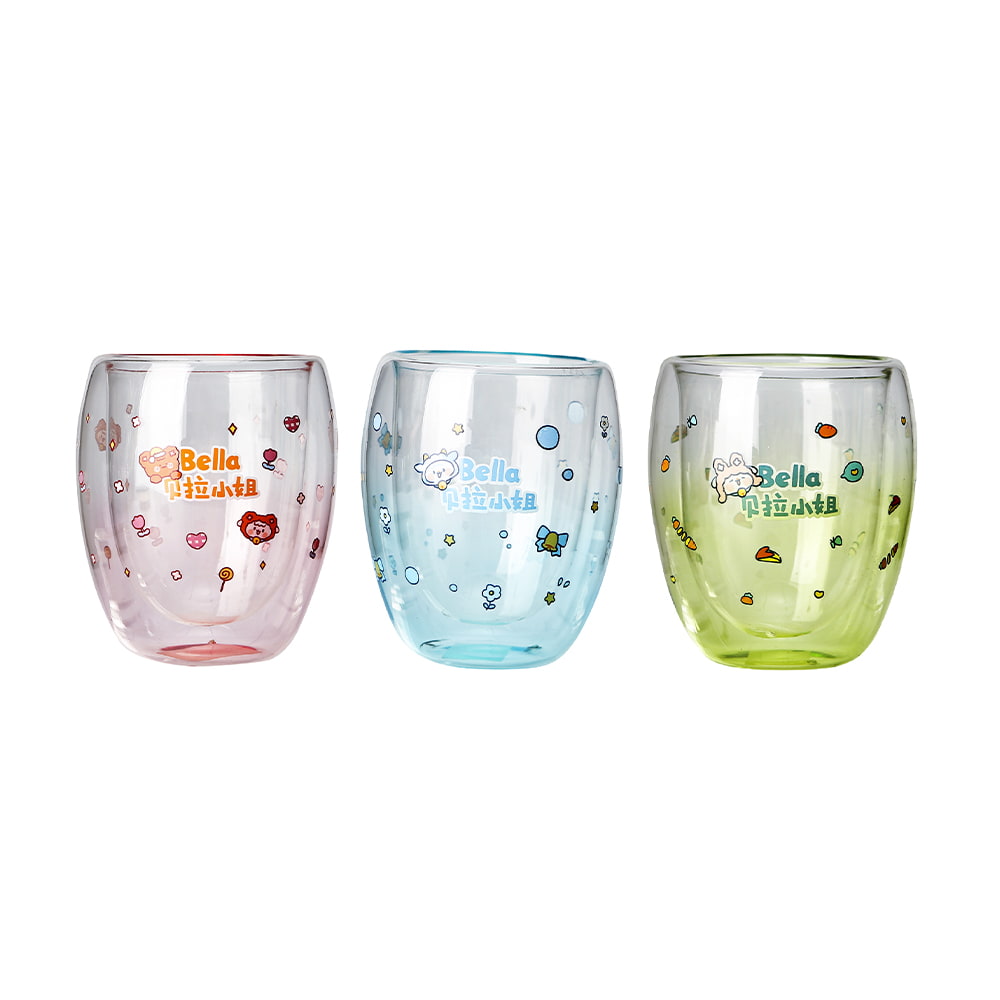 Borosilicate Double Wall Glass MugHandmade The borosilicate double-walled glass mug features an attractive, stylish and modern appearance. It is shatter-resistant, scratch-resistant, durable, safe for ...View Product →
Why Clarity Matters for Food Storage and Drinkware
Clarity is not only aesthetic. In food storage, it affects how users judge the freshness and safety of the contents. If a container looks greenish or cloudy, people instinctively wonder whether the food inside has changed. In a separate study on food perception published in Food Quality and Preference (2021), the visual transparency of the container was found to influence taste expectation by up to 15% of the consumer rating score.
Consider a glass vacuum storage jar keeping dried fruits and spices. The clear body helps anyone in the kitchen see at a glance what is inside without opening the lid. When the glass has 92% transmittance, the colors of the contents are rendered faithfully. At 85%, the same contents lose vibrancy and begin to look dull.
In coffee and tea making, clarity is functional. A glass French press or pour-over brewer with low haze lets the brewer see whether the coffee grounds are fully saturated and whether the extraction is progressing evenly. This is impossible if the glass is hazy. Some drinkware, like the double-wall mug, uses borosilicate not just for clarity but also for thermal comfort. For sealed pantry storage, a glass vacuum storage jar with an air reducer also benefits directly from optical transparency, because the vacuum status is only observable through the glass.
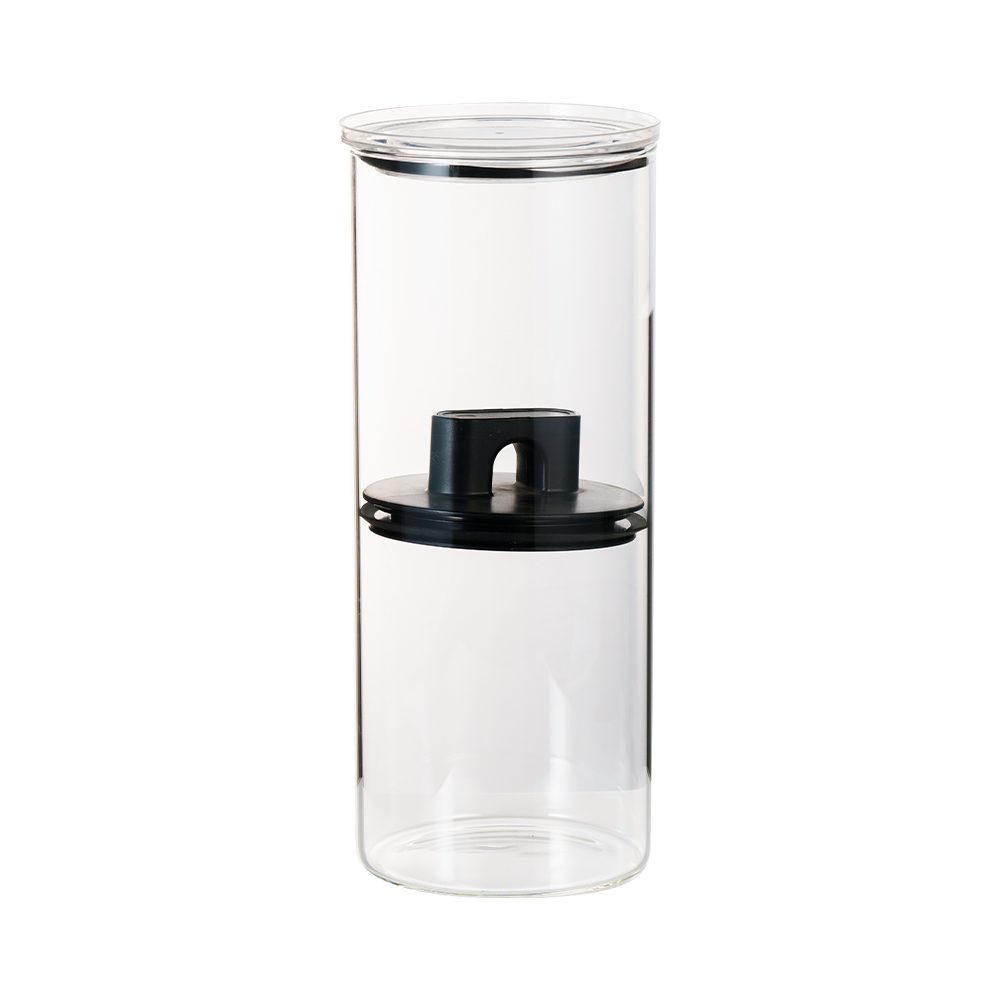 Glass Vacuum Storage JarThe transparent structure makes it easier to check the remaining amount of the product in the jar. Its streamlined and fashionable design is very beautiful.View Product →
Buyer's Checklist: How to Judge Glass Clarity in Finished Products
When you are evaluating glass jars, bottles, or drinkware from a supplier, the following checklist gives you a practical way to verify clarity on the spot.
- Use a phone flashlight. Hold the glass close to the light source and look through it from the opposite side. High-quality glass should appear almost invisible, with no visible greenish or yellowish tint. Any orange glint indicates the presence of iron impurities.
- Check the edge and bottom. Clarity is easiest to judge through the thickest parts of the glass. If the bottom looks disproportionately dark green, the iron content is higher than 0.03%.
- Count bubbles. Look for spherical voids inside the glass body. Any bubble that is visible as a distinct dot should be flagged. The international quality allowance for food-grade glassware is typically one bubble per kilogram of glass, with a maximum diameter of 0.5 mm.
- Evaluate wall thickness uniformity. In a well-formed piece, the wall thickness should be consistent. Wavy or uneven glass is often a sign of inhomogeneous melt, which lowers clarity.
- Look for surface scratches. Fine scratches diffuse light and raise haze. A smooth, polished surface finishes the clarity effort; a scratched surface undoes it.
- Ask for test data. Professional glass suppliers can provide transmittance and haze measurements performed according to ASTM D1003. Request the actual values rather than just a claim of "clear glass."
In the context of kitchen supplies, a good example where clarity expectations are high is the oil and vinegar bottle. Users need to see the level of liquid left and the separation between different oil and vinegar phases. A borosilicate glass auto-open oil and vinegar bottle addresses this practical need by providing a clear material combined with a functional pour spout.
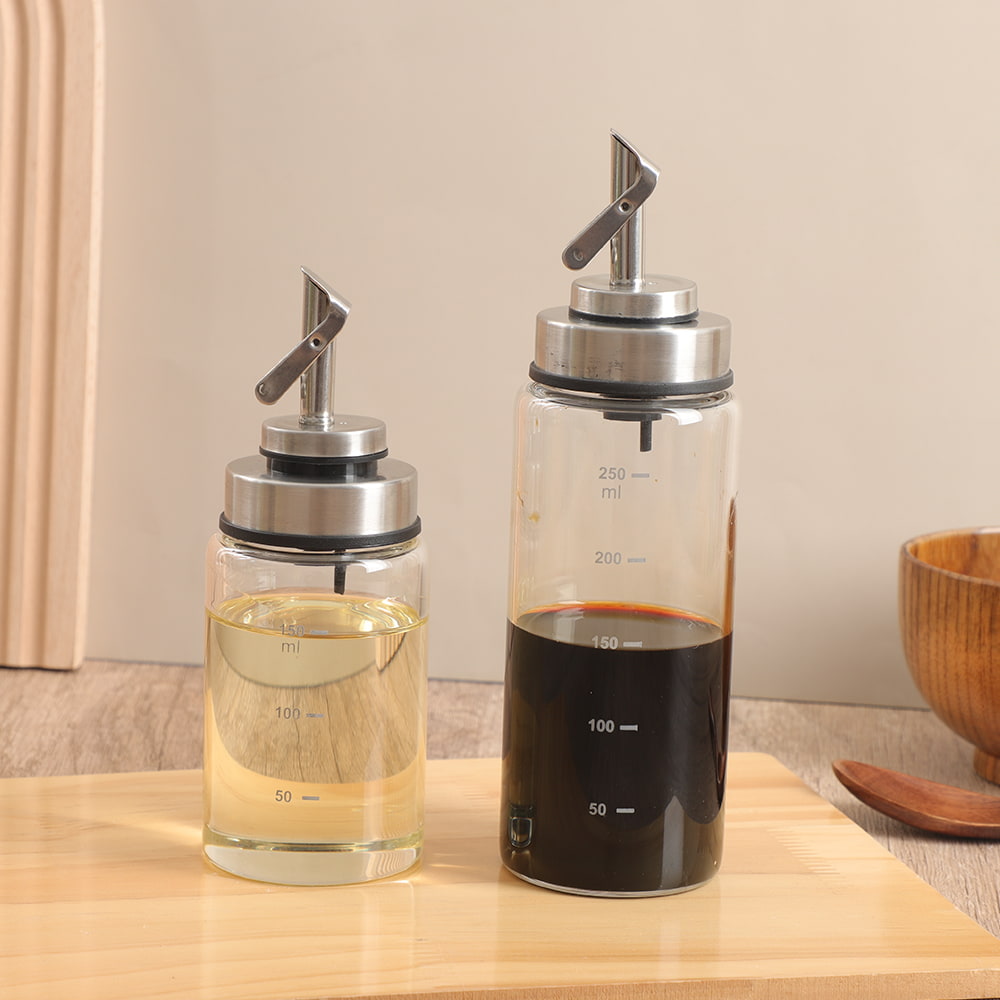 Borosilicate Glass Auto Open Oil/Vinegar BottleEasy to Use When the oil bottle is tilted, the gravity flip cover of the Cheftoon oil dispenser automatically opens and closes when it is upright. It can be easily pou...View Product →
Frequently Asked Questions About Glass Clarity
1. Why does my new glass jar have a green tint?
The green tint comes from iron oxide in the raw silica sand. When Fe2O3 content exceeds 0.03%, the human eye starts to perceive a mint-green cast. This is especially visible when looking through the thick bottom of a jar. Choosing borosilicate glass with Fe2O3 below 0.02% eliminates the tint.
2. Does glass clarity affect food safety?
Not directly. A greenish or slightly opaque glass does not leach chemicals into food. However, low clarity often points to a process with less rigorous quality control, and it may correlate with other defects like entrained bubbles or internal stress, which could reduce durability over time.
3. What is the difference between transparency and clarity?
Transparency is the ability of a material to allow light to pass through it. Clarity is the ability to transmit light without scattering or distortion. A piece of transparent glass can still be hazy, in which case it is transparent but not clear. Haze is the numerical measure of this scattering.
4. Is borosilicate glass always clearer than soda-lime glass?
Usually, yes. Borosilicate glass is produced from higher-purity sand and its thermal expansion is about half that of soda-lime glass, which promotes lower residual stress. That said, a carefully made premium soda-lime glass can approach borosilicate clarity. The practical difference is still roughly 2% transmittance and a slight visible tint.
5. Can glass become cloudy over time?
Yes. Surface etching from repeated dishwasher use, hard water minerals, or even fine scratches from cleaning abrasives will raise the haze. Internal cloudiness from entrapped bubbles or devitrification is permanent, but surface cloudiness can sometimes be polished away.
6. What data should I request from a glass supplier to compare clarity?
Ask for the following measurements: luminous transmittance (ASTM D1003), haze percentage, iron oxide (Fe2O3) content in percent, and residual stress value. If possible, request a certificate of analysis for each production batch. Good suppliers will have these numbers available for their standard products.
Recommended Products


- PRODUCT
- Glass Storage Jar
- Glass/Stainless Steel Drinking ware
- Kitchen Seasoning Containers
- Home Decoration
- QUICK LINKS
- Products
- About Us
- Manufacture
- ODM/OEM
- News
- Contact Us
- CONTACT US
-
-
 7 Crystal Boulevard xi’an Feng Town, Baoying County,Jiangsu, China.
 -
 WhatsApp:
+86-18083783456
+86-15005252638 -
 +86-18083766162
+86-18083783456
+86-15895746638
+86-0514-8866-8898
-
 julia@nchousewares.com
Jack@nchousewares.com
joy@nchousewares.com
-
- CONTACT

